Z3 Verifier
The z3-verifier crate provides a formal verification suite for Jolt. It uses the Z3 SMT solver to mathematically prove properties about Jolt's execution logic and constraint systems. Unlike standard unit tests that check specific inputs, this tool proves properties for all possible inputs.
Structure
The crate is organized into two primary verification modules, sharing common utilities in lib.rs.
src/virtual_sequences.rs: Verifies the decomposed logic of complex instructions.src/cpu_constraints.rs: Verifies the R1CS constraints of the CPU state machine.src/lib.rs: Defines thetemplate_format!macro, which simplifies test generation by providing default operand structures (e.g.,FormatR,FormatI) for instructions.
1. Virtual Sequences (virtual_sequences.rs)
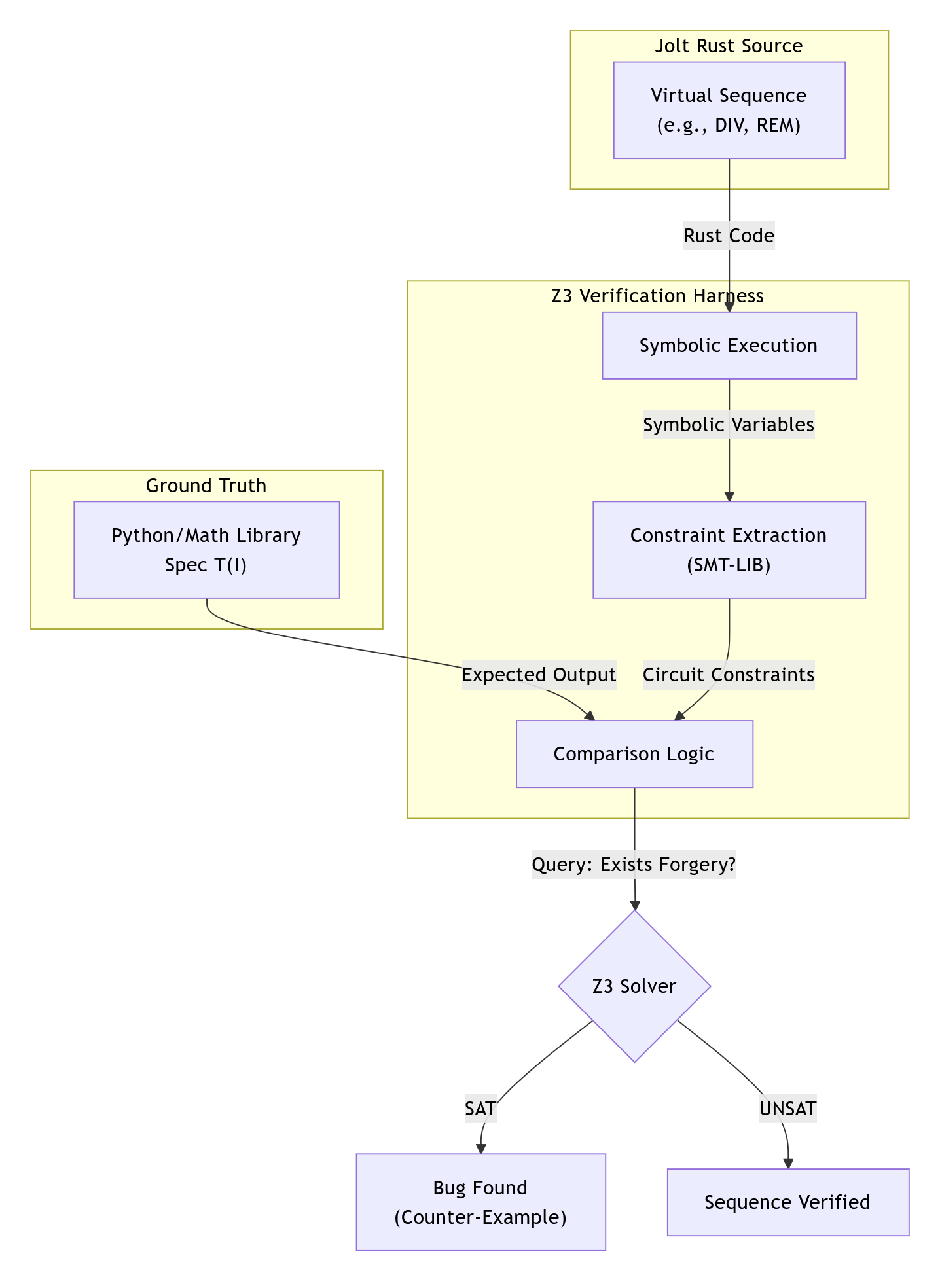
Jolt handles complex RISC-V instructions (like DIV, REM) by decomposing them into sequences of simpler Jolt primitives. This module verifies that these sequences are correct (match the spec) and consistent (deterministic).
Some Virtual sequences make use of VirtualAdvice, which when incorrectly constrained, allow a malicious prover to arbitrarily forge values in destination register for the virtualized instruction.
The Symbolic CPU
The core component is the SymbolicCpu struct. Unlike the standard emulator which operates on u64, this CPU operates on Z3 BitVectors (BV).
- Registers: Tracks as symbolic 64-bit values.
- Advice: Maintains a set of advice variables . When a
VirtualAdviceinstruction is executed, a new unconstrained symbolic variable is created and injected into the register file. - Asserts: Collects boolean constraints (e.g.,
VirtualAssertEQ) generated during execution.
Symbolic Execution
The symbolic_exec function acts as an interpreter, mapping Jolt Instruction variants to Z3 bit-vector operations BV
symbolic_exec(Instruction, State) -> NextState
Standard operations map directly (e.g., ADD -> bvadd), while virtual operations utilize Z3's logic for shifting and arithmetic.
Verification Macros
The test_sequence! macro generates two distinct tests for each instruction:
A. Correctness (test_correctness)
Proves that the Jolt sequence matches the RISC-V specification.
Property: Jolt(input) == RISC-V-Spec(input)
- Setup: Creates a
SymbolicCpu. - Spec Execution: Runs the "Ground Truth" closure on
cpu_expected. - Jolt Execution: Expands the instruction into its virtual sequence and symbolically executes it on the main
cpu. - Query:
Exists input s.t. (cpu.regs != cpu_expected.regs) AND (Asserts are satisfied)- UNSAT: The sequence is correct.
- SAT: A bug was found. The solver provides a counter-example.
B. Consistency (test_consistency)
Proves that the sequence is deterministic, even when relying on prover advice. We define the consistency query by duplicating the execution with independent advice variables A1 and A2.
Property: (Asserts(A1) AND Asserts(A2)) => Out(A1) == Out(A2)
- Setup: Creates two CPUs with identical initial registers (
x1 == x2). - Dual Execution: Executes the sequence on both.
VirtualAdvicegenerates distinct variables (a1for CPU 1,a2for CPU 2). - Query:
Exists input, A1, A2 s.t. (cpu1.regs != cpu2.regs) AND (Asserts1 AND Asserts2 are satisfied)- UNSAT: The constraints are strong enough to force a single unique result.
- SAT: The sequence is under-constrained, allowing multiple valid outputs.
2. R1CS Constraints (cpu_constraints.rs)
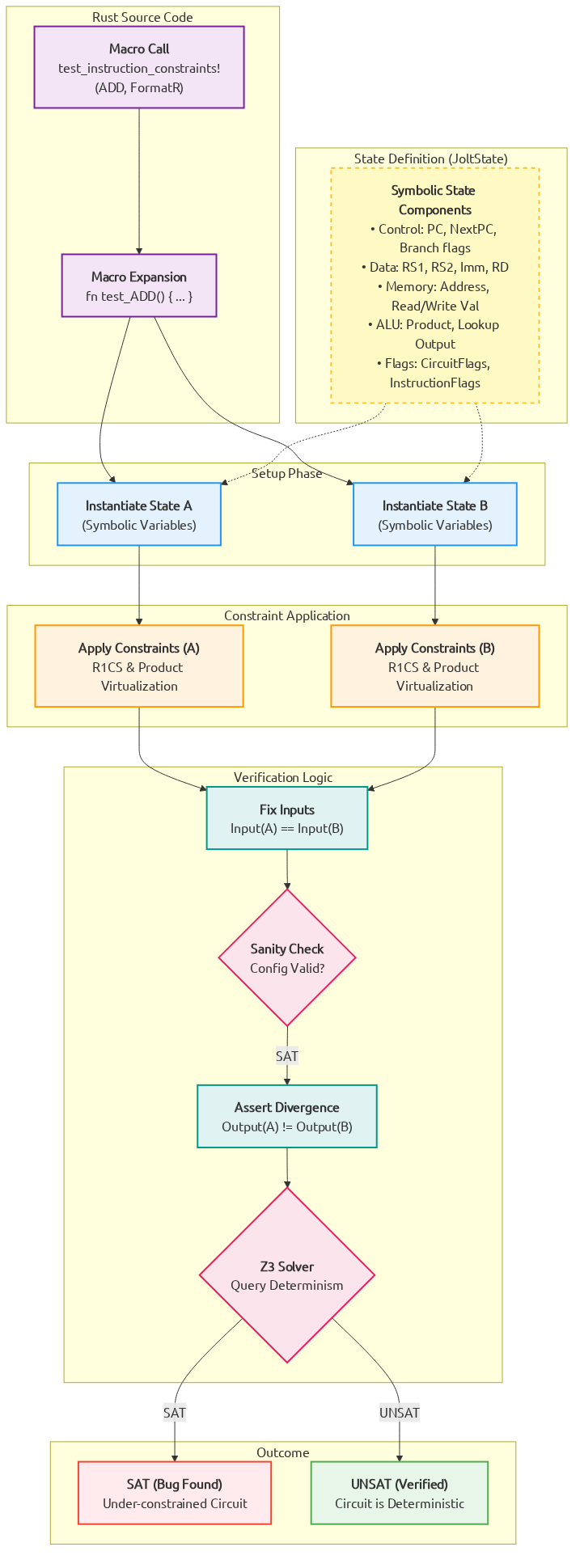
This module verifies the lowest-level circuits that enforce the CPU's state transitions, ensuring Consistency: for a given state and input , there exists exactly one valid next state .
What defines a State?
In the R1CS verifier, a state (JoltState) is a complete symbolic snapshot of a single execution cycle. It is defined by the following variables (modeled as Z3 Integers):
- Control Flow:
pc(current),next_pc(next),unexpanded_pc, andnext_is_noop(padding indicator). - Data Flow:
rs1_value,rs2_value(read inputs),rd_write_value(write-back), andimm(instruction immediate). - Memory Context:
ram_addr(destination address),ram_read_value, andram_write_value. - ALU Witnesses:
left_input,right_input,product(multiplier output), andlookup_output. - System Signals:
CircuitFlags(e.g.,Add,Store,Jump) andInstructionFlags(e.g.,IsRdNotZero,Branch).
Consistency Check (do_test)
The verifier searches for non-deterministic transitions. We verify that the transition function is well-defined:
Property: C(S, I, S1) AND C(S, I, S2) => S1 == S2
- Dual States: Create symbolic states
S1andS2. - Constrain: Apply both R1CS and Product constraints to both states.
- Fix Inputs: Force both states to have identical inputs (same PC, flags, memory reads, and register values).
- Query:
Exists S, I, S1, S2 s.t. S1.outputs != S2.outputs- UNSAT: The circuit is sound (Deterministic).
- SAT: The circuit is under-constrained. The solver found a non-deterministic transition where the same input allows multiple valid next states.
NOTE: All the symbolic variables are modelled using integer arithmetic instead of finite field, which could cause slightly different behaviours. The harness only enforces consistency checks on the r1cs constraints, full formal verification is only guaranteed after correctness modelling against correct RISC-V spec.
Interpreting Results
When the test suite runs (cargo nextest run -p z3-verifier), it outputs SAT or UNSAT. A SAT result indicates a failure in verification. Each Solver::check call carries a fixed timeout and random seed (Z3_TIMEOUT_MS, Z3_RANDOM_SEED in lib.rs); a call that times out fails its test with "Solver failed/timed out, result inconclusive" rather than hanging the run.
Nightly CI
A scheduled workflow (.github/workflows/z3-nightly.yml) runs a subset of the suite nightly against a hermetic Z3 built from pinned vendored source (the crate's vendored-z3 feature), and files a GitHub issue on failure. Its scope is narrower than the full suite: the non-#[ignore]d virtual-sequence proofs plus the per-instruction R1CS determinism checks, and a second step that runs the signed DIV/REM/DIVW/REMW proofs at Z3_VERIFIER_BV_BITS=8 (non-terminating at 64 bits, milliseconds at 8 — see Bit-Width Scaling below). The div/rem family at 64-bit width, the unsigned div/rem and mulh sequences, memory/atomic/CSR expansions, and registered inlines are not covered. It can also be run on demand via workflow_dispatch after changes to tracer/, crates/jolt-program/, or z3-verifier/.
Bit-Width Scaling (Virtual Sequences)
Some virtual sequences (notably those involving division/remainder or high-half multiplication) can be very slow at full 64-bit bitvector width. The virtual_sequences harness supports running the same checks at a scaled-down BitVec width to keep solver runtime manageable while preserving "boundary-condition" structure (e.g., 63 → n-1, 32 → n/2, all-ones masks, signed mins).
Set Z3_VERIFIER_BV_BITS to a power of two in [8, 64] (default: 64):
Z3_VERIFIER_BV_BITS=8 cargo nextest run -p z3-verifier virtual_sequences
1. Correctness Failures (Logic Bugs)
Symptom: test_..._correctness fails.
Meaning: The verifier found a concrete set of inputs where Jolt's output disagrees with the Spec.
Fix: Analyze the provided counter-example. If the logic in symbolic_exec is correct, the virtual sequence in jolt-prover-legacy is likely buggy.
2. Consistency Failures (Under-Constrained Advice)
Symptom: test_..._consistency fails.
Meaning: A malicious prover can choose different advice values to produce different final results, satisfying all constraints. Usually consistency failures in advice also lead to correctness failures since we can find an advice which leads to incorrect results.
Fix: The virtual sequence is missing validation. Add assertions (e.g., VirtualAssertEQ) to tightly constrain the advice.
3. R1CS Consistency Failures
Symptom: test_... in cpu_constraints fails.
Meaning: The R1CS constraints allow multiple next states for the same input.
Fix: Identify the unconstrained variable (e.g., rd_write_value). Add a constraint in crates/jolt-prover-legacy/src/zkvm/r1cs/constraints.rs to force this value to a deterministic state.